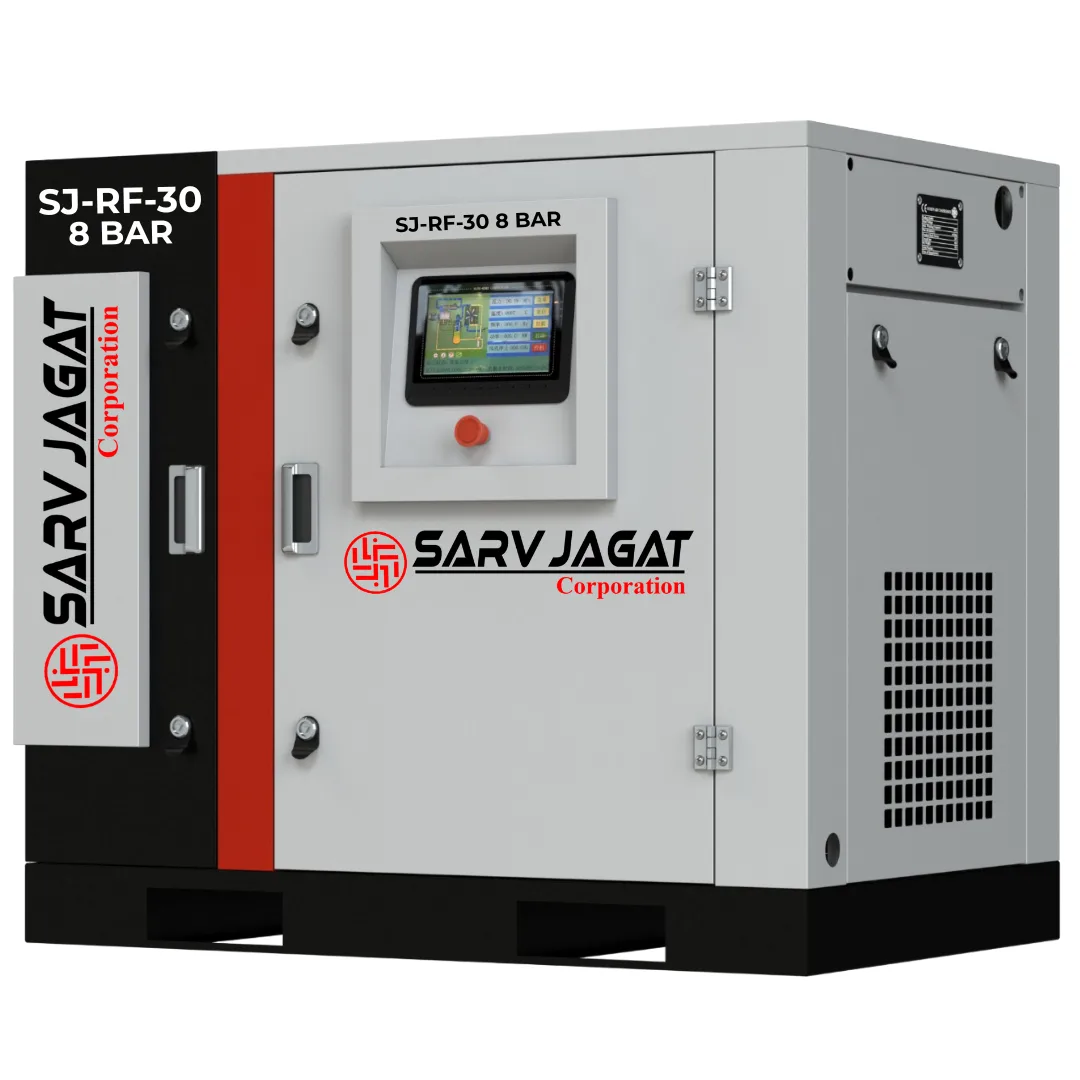
SJ RF 50⚙️ Fixed Speed Direct Drive
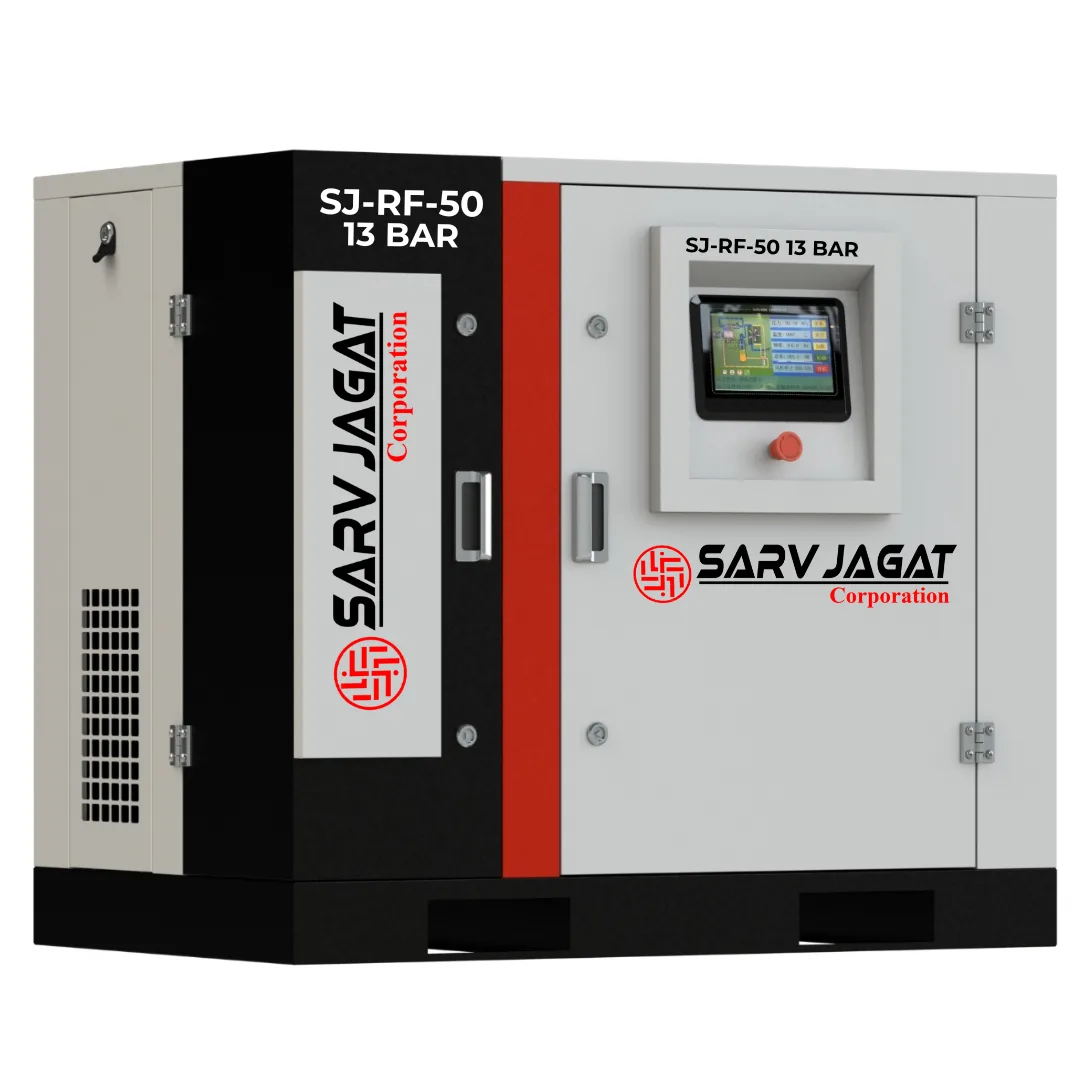
Power: 50 HPDual Voltage (50/60 Hz Global Ready)
✓ ISO 9001:2015 Certified
✓ CE Standard Design
✓ IS 5456 Performance Rating
High Pressure Fixed Speed SJ Screw Air Compressor•Model Code: SJ RF 50
50 HP 13 Bar SJ Fixed Speed Screw Air Compressor
Explore the 50 HP 13 Bar Fixed Speed Screw Air Compressor, delivering 138 CFM at 13 bar. Designed for high-pressure industrial applications.
Motor Power50 HP37 kW Electrical
Working Pressure13 Bar190 PSI Rating
Free Air Delivery138 CFM3.91 m³/min
Factory Price (Ex-Works)₹5,30,000
GST & Export Documentation ReadyCore Engineering Highlights:
Heavy-duty continuous 24/7 industrial duty electric motor (IE3/IE4 standard)
Precision asymmetric twin-screw rotor profile with SKF heavy-duty bearings
Smart MAM-880 micro-computer controller with automatic load/unload cycling
Low acoustic vibration enclosure with sound-absorbing fire-retardant foam lining
Oversized aluminum bar-plate heat exchanger with thermostatic oil control valve
Factory Hotline: +91-9157487233Worldwide Sea-Worthy Packaging
Verified Technical Data Sheet
ENGINEERING SPECIFICATIONS — SJ RF 50
| Specification Parameter | Certified Engineering Rating |
|---|---|
| Motor Power | 50 HP / 37 kW |
| Working Pressure (Discharge) | 13 Bar / 190 PSI(g) / 1.3 MPa(g) |
| Free Air Delivery (FAD Capacity) | 138 CFM / 3.91 m³/min at 13 bar |
| Drive Type | Fixed Speed (Direct Driven) |
| Cooling System | Oversized Vacuum-Brazed Aluminum Heat Exchanger |
| Micro-Controller PLC | MAM-880 Intelligent Micro-Computer with RS-485 Modbus |
| Electrical Grid Compatibility | 415V ±10% / 3-Phase / 50 Hz (Dual Voltage 50/60 Hz Available) |
| Operating Sound Level | 66 ± 2 dB(A) Acoustic Enclosure |
| Unit Dimensions (L × W × H) | 1600 x 1050 x 1500 mm |
| Approx. Net Weight | 1250 kg |
| Cooling Method | High Efficiency Air Cooled |
| Voltage & Frequency | 415V ±10% / 3-Phase / 50 Hz |
| Stage | Single Stage |
| Type | Fixed Speed |
| Technology | Oil Injected Rotary Screw |
| Drive | Direct Driven |
Technical Documentation & Plant Application Guide
PRODUCT OVERVIEW & ENGINEERING GUIDE
Authored by Sarv Jagat Corporation Engineering Team • Official Product Whitepaper
50 HP 13 Bar SJ Fixed Speed Screw Air Compressor
The SJ RF50 is a 50 HP industrial fixed-speed rotary screw air compressor developed for applications requiring a higher-pressure compressed air supply with substantial airflow capacity. Operating at 13 bar pressure, it delivers 138 CFM (3.91 m³/min), making it suitable for selected heavy-duty pneumatic systems, abrasive blasting installations and specialised industrial processes.
Powered by a 37 kW motor, the SJ RF50 combines single-stage rotary screw compression with fixed-speed operation. It is designed for industrial environments where connected equipment requires elevated air pressure and a consistent supply of compressed air within the compressor's rated delivery capacity.
Unlike conventional 7–10 bar compressor installations, a 13 bar configuration is selected when the downstream machinery or process specifically requires higher working pressure. The RF50 is therefore intended for applications where both pressure requirements and total air consumption have been evaluated before equipment selection.
WHY CHOOSE THE 50 HP CAPACITY?
Selecting a 50 HP compressor is not simply about choosing a larger motor. The important factors are the required operating pressure, total compressed air consumption, simultaneous equipment demand and the operating profile of the production facility.
The SJ RF50 provides 138 CFM at 13 bar, offering a higher airflow capacity than smaller 10 HP, 15 HP, 20 HP, 25 HP, 30 HP and 40 HP configurations in the same pressure category.
This capacity can be evaluated for:
• Industrial abrasive blasting installations with higher air consumption.
• Heavy-duty pneumatic equipment requiring elevated working pressure.
• Dedicated construction and infrastructure equipment air supplies.
• Selected industrial drilling and material-handling systems.
• Special-purpose machinery with higher-pressure pneumatic circuits.
• Manufacturing facilities operating multiple compatible pneumatic stations.
The available airflow must always be compared with the combined consumption of equipment operating simultaneously. For example, a blasting installation with several operating nozzles may exceed the RF50's 138 CFM capacity depending on nozzle diameter and working pressure.
13 BAR HIGH-PRESSURE OPERATING CONFIGURATION
The SJ RF50 is configured for a maximum operating pressure of 13 bar(g), equivalent to 190 PSI(g) or 1.3 MPa(g), according to its specification.
Higher-pressure compressed air is relevant in applications where equipment design or process requirements demand more pressure than a conventional industrial air network provides.
However, operating pressure and airflow must be considered together. Increasing the pressure requirement generally reduces the available airflow from a given compressor configuration.
The SJ RF50 specification provides the following pressure-wise delivery reference:
• 8 bar: 240 CFM / 6.79 m³/min
• 10 bar: 191 CFM / 5.41 m³/min
• 13 bar: 138 CFM / 3.91 m³/min
These figures demonstrate why compressor selection should be based on the actual working pressure rather than the highest airflow figure listed for the model.
Where connected machinery requires lower pressure, an appropriately rated downstream pressure regulator can be used. A 13 bar compressor should not be selected solely to supply ordinary low-pressure pneumatic equipment unless the wider system design justifies it.
ADVANCED SINGLE-STAGE ROTARY SCREW COMPRESSION TECHNOLOGY
The SJ RF50 uses single-stage rotary screw compression technology for industrial compressed air generation.
The rotary screw compression principle uses two intermeshing helical rotors to reduce the volume of trapped air as it moves through the compression chamber. This produces a continuous compressed air stream rather than the reciprocating delivery pulses associated with piston compressors.
The compression system is designed around the following operating principles:
• Continuous rotary compression: Air is compressed through the rotation of the screw rotor assembly.
• Controlled air intake: The intake arrangement supplies atmospheric air to the compression element.
• Oil circulation and separation: In an oil-injected configuration, lubricating oil supports sealing, cooling and lubrication, followed by oil separation from the compressed air stream.
• Pressure generation: The compression system is configured for the specified operating pressure.
• Downstream air delivery: Compressed air is directed towards the connected receiver or distribution system.
The final air-end, lubrication and separation arrangement should be confirmed against the supplied machine configuration and approved technical documentation.
FIXED SPEED OPERATING TECHNOLOGY
The SJ RF50 uses fixed-speed operating technology with a 50 HP, 37 kW motor.
During loaded operation, the motor operates at its configured rotational speed. Compressor capacity is generally regulated through a load/unload control arrangement rather than continuously changing motor speed.
This operating method is suitable for installations with a relatively predictable compressed air demand and an operating profile that can be matched to the compressor's capacity.
Key operating characteristics include:
• Fixed motor speed during loaded operation.
• Load/unload-based capacity regulation, subject to controller configuration.
• Continuous rotary screw compression while loaded.
• Air delivery determined by the compressor configuration and operating pressure.
• Electrical demand influenced by loading pattern, operating pressure and unloaded running time.
For facilities with substantial fluctuations in air demand, a demand assessment is important. Frequent unloading or extended unloaded operation can affect overall energy consumption. A VFD compressor or a properly designed combination of compressors may be worth evaluating where the demand profile justifies it.
PREMIUM INDUSTRIAL COMPONENTS & SYSTEM DESIGN
A 50 HP, 13 bar compressor requires correctly selected mechanical, electrical and air-treatment components to operate as part of a reliable industrial compressed air installation.
The SJ RF50 configuration is based on the functional requirements of an industrial rotary screw compressor system.
Important component groups include:
1. Rotary Screw Air-End
The air-end performs the primary compression operation through the intermeshing screw rotors. Its selection must be suitable for the intended pressure and operating conditions.
2. Industrial Electric Motor
The 50 HP / 37 kW motor provides the mechanical power required to drive the compression system. Motor electrical specifications and protection must be matched to the installation's power supply.
3. Air Intake Filtration
The intake filtration system helps prevent airborne dust and particulate matter from entering the compression element. Filter inspection and replacement are important, particularly in dusty industrial environments.
4. Lubrication and Oil Filtration
The lubrication arrangement supports the operation of an oil-injected screw compression system. Oil filtration helps control contaminants circulating through the lubrication circuit.
5. Air-Oil Separation System
The separator removes oil from compressed air in an oil-injected configuration. Its condition influences downstream oil carryover and compressor operation.
6. Cooling Arrangement
Oil cooling and compressed air aftercooling arrangements help manage heat generated during compression. Cooling performance depends on the supplied configuration, ambient conditions and ventilation.
7. Electrical Control System
The electrical panel and configured control system manage compressor operation and provide the applicable operating protections.
8. Pressure and Temperature Monitoring
Operating parameters should be monitored through the instruments and protection devices provided with the supplied configuration.
COMPRESSOR SELECTION & INSTALLATION CONSIDERATIONS
For a 50 HP compressor operating at 13 bar, correct system design is as important as selecting the compressor itself.
Before installation, evaluate:
• Actual air consumption of each connected machine.
• Required working pressure at the point of use.
• Pressure drop across filters, dryers, piping and fittings.
• Simultaneous operation of pneumatic equipment.
• Required air quality and pressure dew point.
• Receiver capacity and demand fluctuations.
• Ambient temperature and compressor-room ventilation.
• Electrical supply, cable sizing and protection.
• Pressure ratings of all downstream components.
The receiver, dryer, filters, separators, valves, drains, hoses, fittings and distribution piping must be rated for the intended operating pressure and temperature. Conventional 7–10 bar components must not be assumed suitable for a 13 bar installation.
For applications involving direct product contact or critical manufacturing processes, compressed air treatment must be selected according to the applicable air-quality specification. A compressor alone does not guarantee oil-free or contamination-free compressed air.
The final installation should be designed around the actual operating requirements of the connected machinery, not simply the compressor's motor horsepower.
HEAVY-DUTY COOLING SYSTEM
The SJ RF50 50 HP screw air compressor incorporates a cooling arrangement to manage the heat generated during compression and lubrication. Thermal management is particularly important in high-pressure compressor operation because compression at elevated pressure increases the heat load on the system.
The cooling arrangement supports:
• Heat removal from circulating compressor oil.
• Temperature management of the compression system.
• Cooling of compressed air through the aftercooling arrangement, where supplied.
• Heat dissipation through the compressor ventilation system.
For reliable operation, the compressor should be installed in a properly ventilated location with sufficient clearance around air intake and cooling areas. Cooling surfaces should be inspected and cleaned periodically to prevent dust accumulation and restricted airflow.
Actual cooling configuration depends on the supplied machine variant.
INTELLIGENT ELECTRICAL & SAFETY FEATURES
The SJ RF50 uses an industrial electrical and control arrangement designed to manage compressor operation. The exact monitoring functions and protection features depend on the supplied electrical panel and controller configuration.
Important electrical and operational considerations include:
• Motor overload protection according to motor and electrical specifications.
• Pressure monitoring through the supplied pressure-control arrangement.
• Temperature monitoring and applicable high-temperature protection.
• Emergency stop provision as per the supplied electrical panel.
• Load/unload control for fixed-speed compressor operation.
• Electrical protection selected according to the installation's power supply.
Operators should monitor operating pressure, temperature, abnormal noise and controller indications during operation. Electrical protection settings must be matched to the motor nameplate and applicable electrical standards.
STANDARD FEATURES
The SJ RF50 is based on an industrial rotary screw compressor arrangement. The following functional systems form part of the machine design, with the exact supply scope subject to the approved technical quotation:
• 50 HP / 37 kW industrial electric motor.
• Single-stage rotary screw compression system.
• Fixed-speed operating arrangement.
• Air intake filtration system.
• Compressor lubrication and oil filtration arrangement.
• Air-oil separation system.
• Oil cooling arrangement.
• Compressed air aftercooling arrangement, where supplied.
• Electrical control panel.
• Pressure-control and load/unload operating arrangement.
• Industrial enclosure and ventilation arrangement, as applicable.
OPTIONAL FEATURES & COMPRESSED AIR SYSTEM ACCESSORIES
The SJ RF50 can be integrated with additional compressed air treatment and distribution equipment to suit the requirements of the production facility.
1. Air Receiver Tank
A pressure-rated air receiver stores compressed air and supports fluctuations in demand. It can also help reduce frequent compressor loading and unloading when correctly sized. Receiver volume should be selected according to the air-consumption profile and system design.
2. Refrigerated Air Dryer
A refrigerated air dryer removes moisture by cooling compressed air and separating the condensed water. It is suitable for installations where the required pressure dew point can be achieved using refrigerated drying technology.
3. Desiccant Air Dryer
For applications requiring lower pressure dew points, a desiccant dryer may be selected. It is commonly considered for critical industrial processes where moisture control is more demanding.
4. Moisture Separator
A moisture separator removes bulk liquid water from compressed air before it enters downstream air-treatment equipment.
5. Pre-Filter and After-Filter
Pre-filters and after-filters help remove particulate contamination and oil aerosols according to their filtration grades. Their selection should be based on the required compressed air quality.
6. Micro-Filter
A micro-filter can provide finer particulate and oil aerosol filtration where the downstream process requires it.
7. Activated Carbon Filter
An activated carbon filter may be used to reduce residual oil vapour and odour. It should be selected as part of a correctly designed air-treatment system and does not replace other required filtration stages.
8. Automatic Condensate Drain
Automatic condensate drains remove accumulated liquid from receivers, filters and other designated collection points. Correct drain selection helps prevent condensate accumulation in the compressed air network.
9. Aluminium Compressed Air Piping
An appropriately sized aluminium piping network can distribute compressed air across production areas. Pipe diameter, pressure rating, fittings, connection losses and future expansion requirements should be considered during system design.
10. Oil-Water Separator
An oil-water separator can be installed to treat oil-contaminated compressor condensate before disposal, subject to applicable environmental and wastewater requirements.
13 BAR SYSTEM COMPATIBILITY NOTE
For the SJ RF50 13 bar installation, all downstream equipment must be suitable for the intended operating pressure and temperature.
This includes:
• Air receiver tanks.
• Refrigerated and desiccant dryers.
• Moisture separators and filters.
• Automatic condensate drains.
• Pressure regulators and safety valves.
• Hoses, fittings and distribution piping.
Do not assume that equipment designed only for conventional 7–10 bar systems is suitable for a 13 bar installation.
Where connected machinery requires a lower working pressure, an appropriately rated pressure regulator should be installed. The pressure rating of every component must be checked before commissioning.
TECHNICAL SPECIFICATIONS
Model: SJ RF50
Product Type: Industrial Screw Air Compressor
Compressor Series: R Series – Fixed Speed
Power Rating: 50 HP
Motor Power: 37 kW
Operating Pressure: 13 bar(g)
Pressure Equivalent: 190 PSI(g)
Pressure Equivalent: 1.3 MPa(g)
Air Delivery at 13 bar: 138 CFM
Air Delivery at 13 bar: 3.91 m³/min
Compression Technology: Single-Stage Rotary Screw
Operating Technology: Fixed Speed
PRESSURE-WISE AIR DELIVERY REFERENCE
At 8 bar:
240 CFM / 6.79 m³/min
At 10 bar:
191 CFM / 5.41 m³/min
At 13 bar:
138 CFM / 3.91 m³/min
These are model-specific airflow reference values. For a 13 bar installation, use the rated delivery of 138 CFM / 3.91 m³/min for preliminary system sizing.
Final compressor selection must consider actual consumption, simultaneous machine operation, pressure losses, leakage, required reserve capacity and the operating conditions of the installation.
INDUSTRIAL APPLICATIONS
The SJ RF50 50 HP 13 Bar compressor is intended for evaluating industrial systems where both higher operating pressure and substantial compressed air demand are required.
Its 138 CFM delivery at 13 bar makes it relevant to selected heavy-duty pneumatic installations. Application suitability must be established by checking the equipment manufacturer's pressure and airflow requirements.
1. Abrasive Blasting & Industrial Sandblasting
Potential applications include:
• Industrial pressure blast pots.
• Abrasive blasting cabinets with suitable high-pressure systems.
• Blast-room compressed air installations.
• Steel structure surface preparation.
• Industrial equipment and component surface treatment.
Blasting air consumption depends heavily on nozzle diameter, nozzle pressure, abrasive type and the number of simultaneously operating nozzles. The total demand must remain within the available 138 CFM, allowing for system pressure losses.
2. Construction & Infrastructure Equipment
Selected pneumatic construction equipment can require higher-pressure compressed air, including:
• Pneumatic breakers.
• Jackhammers.
• Rock drilling equipment.
• Selected pneumatic demolition tools.
• Specialised construction air-operated machinery.
The RF50 can be evaluated for these applications where the required working pressure and simultaneous airflow demand match its rated delivery.
3. Mining & Drilling Equipment
Potential applications include selected:
• Pneumatic drilling systems.
• Rock drilling equipment.
• Industrial drilling support systems.
• High-pressure pneumatic material-handling equipment.
For down-the-hole drilling rigs and other specialised drilling equipment, verify the manufacturer's required pressure and air consumption. Some drilling applications require substantially more airflow than a 50 HP compressor can provide.
4. Heavy-Duty Pneumatic Tools
The RF50 can be considered for dedicated pneumatic tool installations where equipment specifications call for higher working pressure.
Examples include:
• Industrial impact wrenches.
• Pneumatic riveting equipment.
• Heavy-duty air-operated tools.
• Specialised pneumatic assembly equipment.
• Selected high-pressure actuators.
The total demand of tools operating simultaneously must be calculated before selecting the compressor.
5. Industrial Pneumatic Conveying
Selected pressure conveying systems for powders, granules and other industrial materials may require elevated compressed air pressure.
Potential applications include:
• Industrial powder conveying.
• Granular material transfer.
• Specialised pneumatic transfer systems.
• Process material handling.
Conveying distance, pipeline diameter, material characteristics, solids loading and required airflow determine compressor suitability.
6. Heavy Engineering & Fabrication
Selected high-pressure pneumatic systems used in engineering and fabrication facilities may be evaluated against the RF50's pressure and airflow capacity.
Potential applications include:
• Special-purpose pneumatic fixtures.
• Heavy-duty air-operated clamping systems.
• Dedicated fabrication equipment.
• Specialised pneumatic production stations.
• Industrial assembly equipment requiring elevated pressure.
7. Pneumatic Component Manufacturing & Testing
Certain pneumatic component manufacturing processes and equipment may require higher-pressure compressed air.
Potential applications include:
• Specialised pneumatic component assembly.
• Dedicated air-operated testing equipment.
• OEM machinery commissioning systems.
• High-pressure pneumatic control circuits.
The RF50 must not be treated as a substitute for dedicated hydraulic or hydrostatic pressure-testing equipment. Testing arrangements must use the specified test medium and equipment designed for the relevant test pressure and safety requirements.
8. Special-Purpose Machinery & Industrial OEM Systems
The compressor can be evaluated for dedicated OEM machinery, industrial automation equipment and specialised production systems where the equipment manufacturer specifies a suitable high-pressure compressed air supply.
APPLICATION SELECTION NOTE
A 13 bar compressor is not automatically the correct choice for every industrial plant. Standard CNC machines, VMCs, robotic grippers, general packaging machines and common pneumatic actuators frequently operate at lower pressures unless their OEM specifications state otherwise.
The RF50 should be selected when the connected process genuinely requires higher pressure and its total air consumption can be supported by 138 CFM at 13 bar.
FREQUENTLY ASKED QUESTIONS
1. What is the air delivery of the SJ RF50 50 HP compressor at 13 bar?
The SJ RF50 delivers 138 CFM, equivalent to 3.91 m³/min, at 13 bar according to the official model specification.
2. What is the motor power of the SJ RF50?
The SJ RF50 has a rated motor power of 50 HP, equivalent to 37 kW.
3. What is the maximum operating pressure of the SJ RF50?
The specified maximum operating pressure is 13 bar(g), equivalent to 190 PSI(g) or 1.3 MPa(g).
4. Is the SJ RF50 suitable for sandblasting?
It can be evaluated for industrial sandblasting and abrasive blasting installations. Actual suitability depends on blast nozzle diameter, nozzle pressure, number of operating nozzles and total compressed air consumption.
5. Can this compressor supply pneumatic breakers and drilling equipment?
Selected pneumatic breakers and drilling equipment can be considered if their required pressure and airflow are within the compressor's rated capacity. Large drilling rigs may require considerably higher airflow.
6. What is the difference between the RF50 8 bar, 10 bar and 13 bar configurations?
The specified airflow differs according to operating pressure:
• 8 bar: 240 CFM.
• 10 bar: 191 CFM.
• 13 bar: 138 CFM.
Higher operating pressure results in lower specified airflow for this model. Select the configuration according to the actual process requirement.
7. Can the RF50 supply air to machinery requiring 7 or 8 bar?
Yes, an appropriately rated pressure regulator can reduce downstream pressure for machinery requiring a lower working pressure. The system should be designed to account for pressure losses and the required airflow at the point of use.
8. Which air dryer is suitable for the RF50?
A refrigerated or desiccant dryer may be selected according to the required pressure dew point and air-quality specification. Dryer capacity must be evaluated at actual inlet pressure, temperature and ambient operating conditions.
9. What air receiver tank capacity is recommended?
Receiver capacity depends on the demand profile, permissible pressure fluctuation, compressor control arrangement and required stored-air duration. It should be calculated for the installation rather than selected using motor horsepower alone.
10. Is the RF50 a fixed-speed or VFD compressor?
The SJ RF50 is a fixed-speed rotary screw compressor. Its motor operates at a configured speed during loaded operation, with capacity regulation generally managed through load/unload control.
11. Can the SJ RF50 operate continuously?
Operating suitability depends on the approved machine duty rating, ambient conditions, ventilation, maintenance, electrical supply and actual load profile. Continuous operation should be confirmed against the supplied manufacturer's operating documentation.
12. What maintenance is required for the SJ RF50?
Maintenance generally includes inspection and servicing of the air intake filter, compressor oil, oil filter, air-oil separator, cooling surfaces, condensate drains, electrical connections and operating parameters. Follow the supplied maintenance schedule and actual operating conditions.
13. How should I select the correct 50 HP compressor for my application?
Identify the required working pressure, calculate the total air consumption of connected equipment, determine simultaneous operating demand and account for pressure losses and leakage. For the SJ RF50 at 13 bar, the key rated delivery reference is 138 CFM / 3.91 m³/min.
WHY CHOOSE SARV JAGAT?
Sarv Jagat Corporation provides industrial compressed air solutions for manufacturing facilities, engineering companies and specialised industrial applications.
The SJ RF50 50 HP 13 Bar Fixed Speed Screw Air Compressor is designed for installations that require a higher-pressure compressed air supply with a specified delivery of 138 CFM at 13 bar.
Our compressed air solutions focus on:
• Industrial rotary screw compressor configurations.
• Multiple motor power and operating pressure options.
• Application-based compressor selection.
• Air receiver and compressed air treatment integration.
• Industrial spare parts and service support.
• Compressed air requirements for manufacturing and process industries.
For a technically appropriate compressor selection, share your required operating pressure, total air consumption, connected machinery, operating hours and air-quality requirements with Sarv Jagat.
Our team can evaluate whether the SJ RF50 is suitable for your installation and identify the required air receiver, dryer, filtration and distribution accessories.
Sarv Jagat Corporation
Ahmedabad, Gujarat, India
Industrial Air Compressors | Sales | Spares | Service | Export.
Complementary Equipment
View All 84 ModelsRelated Industrial Screw Compressors
SJ RF 10Fixed
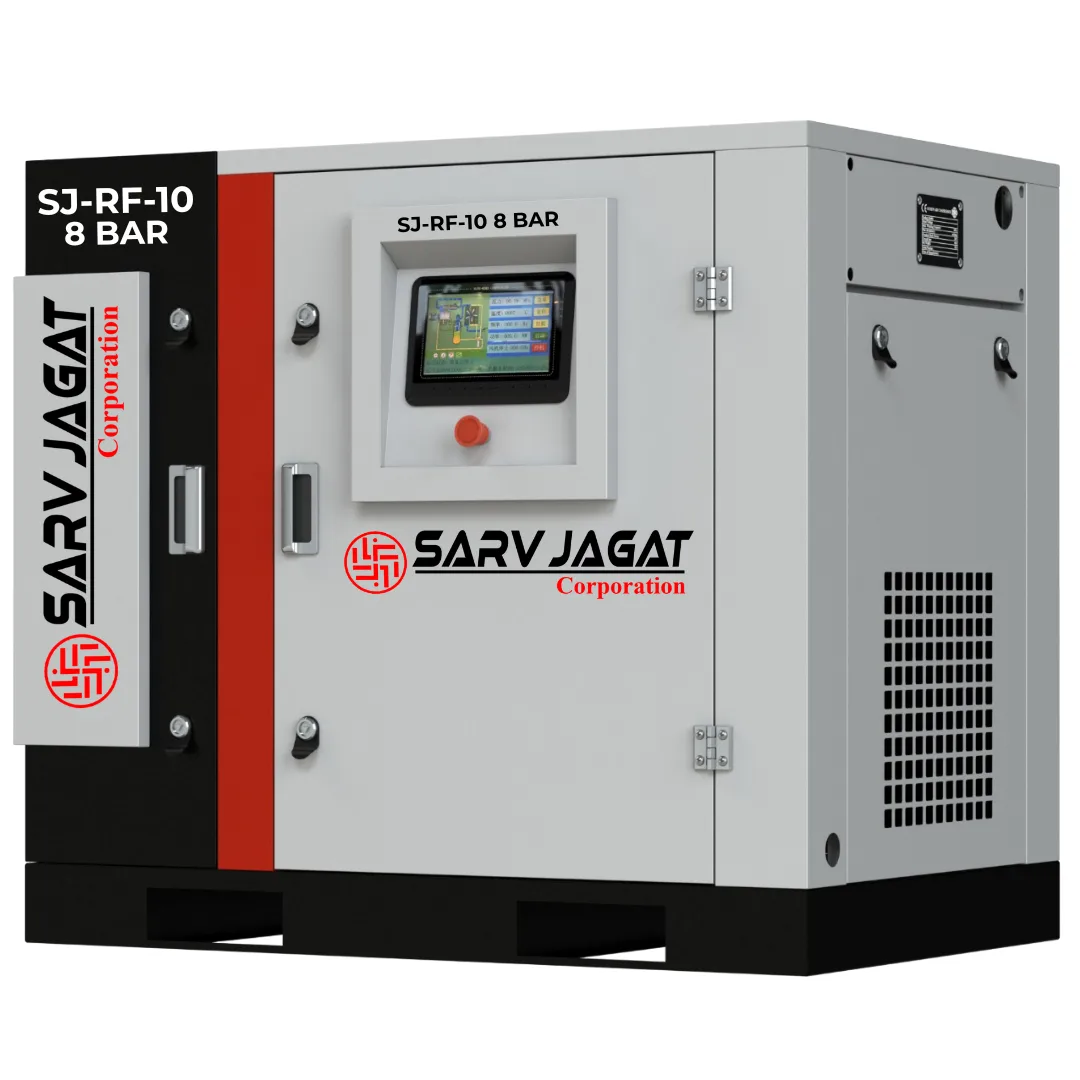
⚙️ Fixed Speed Drive
10 HP 8 Bar SJ Fixed Speed Screw Air Compressor
Buy 10 HP 8 Bar Fixed Speed Screw Air Compressor from Sarv Jagat. Delivers 45 CFM with reliable rotary screw technology, energy efficient & Low maintenance.
Power10 HP7.5 kW
Pressure8 Bar116 PSI
Air Delivery45 CFM1.27 m³/m
SJ RF 20Fixed
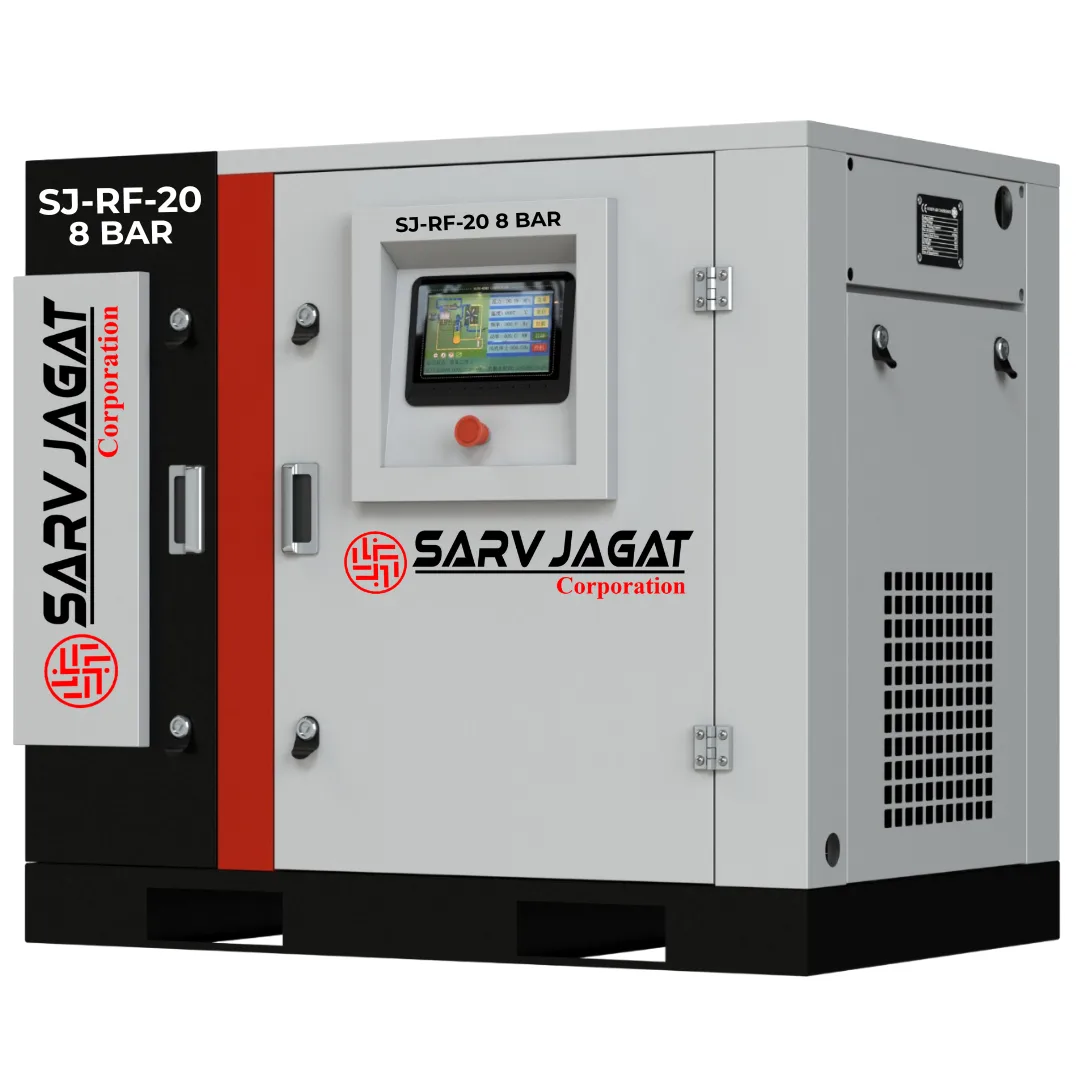
⚙️ Fixed Speed Drive
20 HP 8 Bar SJ Fixed Speed Screw Air Compressor
Buy SJ RF20 20 HP 8 Bar Fixed Speed Screw Air Compressor. 85 CFM (2.41 m³/min), oil injected rotary screw technology for industrial use.
Power20 HP15 kW
Pressure8 Bar115 PSI
Air Delivery85 CFM2.41 m³/m