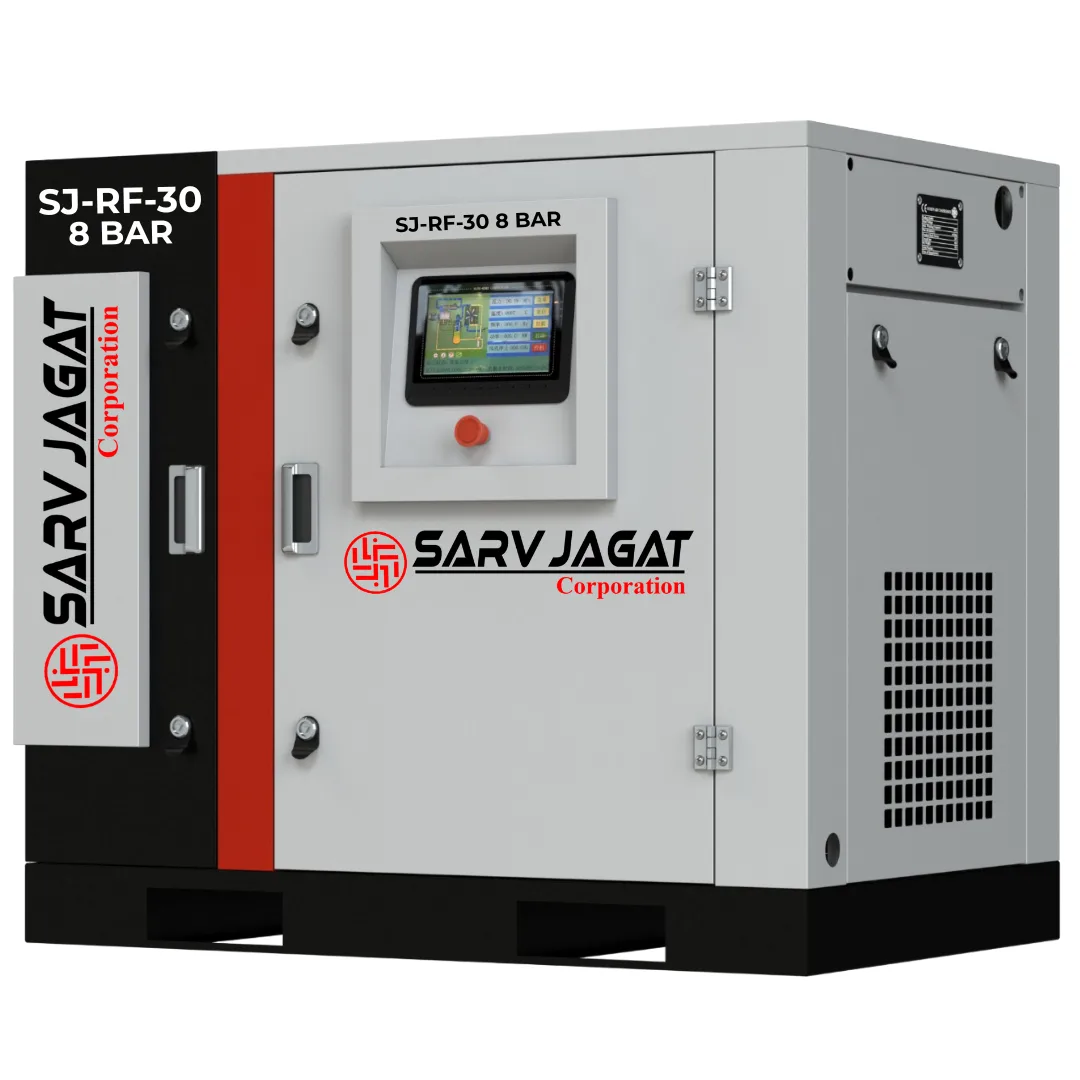
SJ RV 220⚡ Permanent Magnet VFD
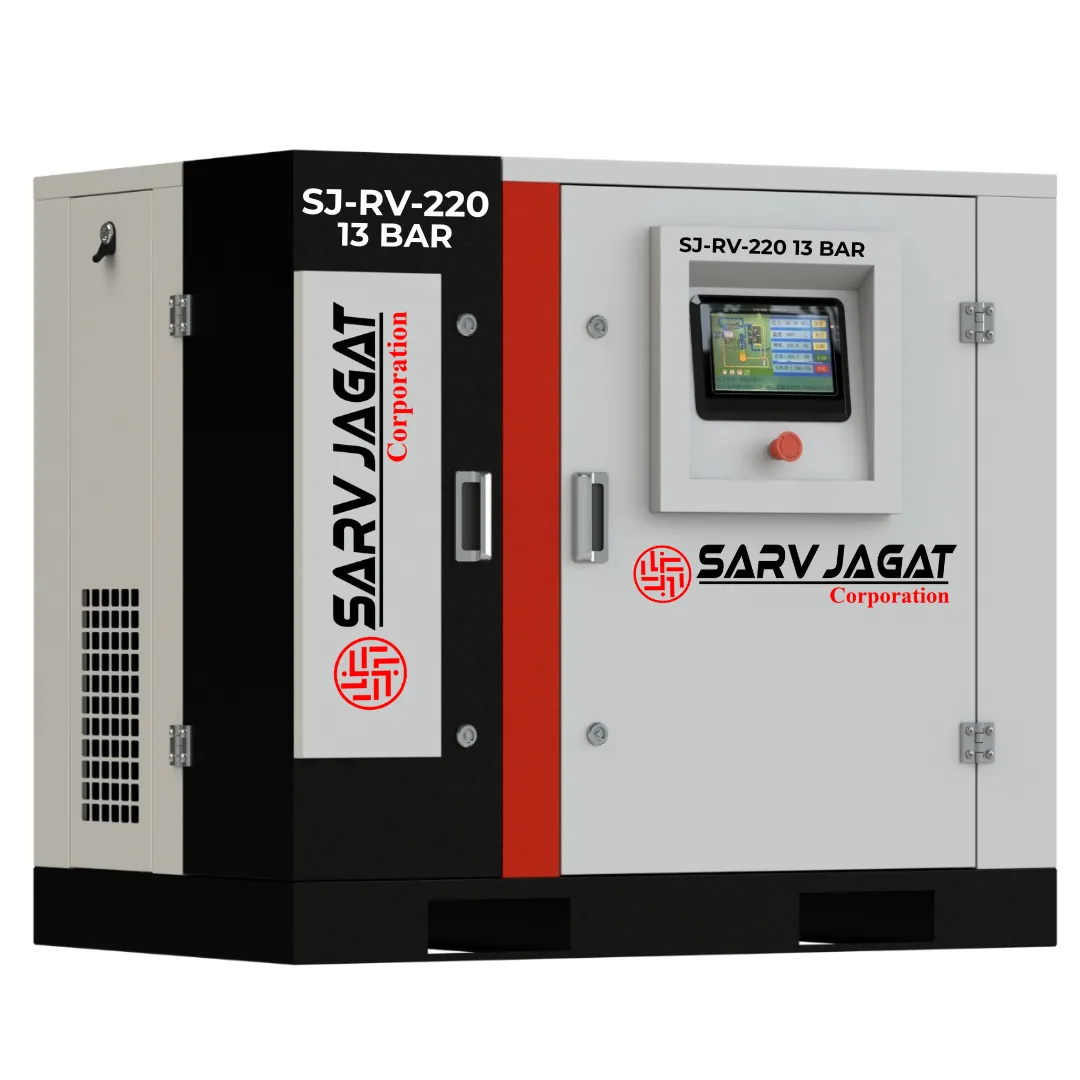
Power: 220 HPDual Voltage (50/60 Hz Global Ready)
✓ ISO 9001:2015 Certified
✓ CE Standard Design
✓ IS 5456 Performance Rating
High Pressure Variable Speed SJ Screw Air Compressor VFD/VSD•Model Code: SJ RV 220
220 HP 13 Bar SJ VFD Variable Speed Screw Air Compressor
The 220 HP VFD screw air compressor delivers 740 CFM at 13 bar. Designed for high-pressure industrial compressed air systems for mining and heavy engineering.
Motor Power220 HP160 kW Electrical
Working Pressure13 Bar190 PSI Rating
Free Air Delivery740 CFM20.95 m³/min
Core Engineering Highlights:
Permanent Magnet Synchronous Motor (IE4 super-premium efficiency rating)
Advanced vector inverter frequency control saving up to 35% on electrical costs
Precision asymmetric twin-screw rotor profile with SKF heavy-duty bearings
Smart MAM-880 micro-computer controller with pressure & temperature protection
Soft-start zero inrush current design extending motor and mechanical life
Factory Hotline: +91-9157487233Worldwide Sea-Worthy Packaging
Verified Technical Data Sheet
ENGINEERING SPECIFICATIONS — SJ RV 220
| Specification Parameter | Certified Engineering Rating |
|---|---|
| Motor Power | 220 HP / 160 kW |
| Working Pressure (Discharge) | 13 Bar (g) / 190 PSI (g) / 1.3 MPa (g) |
| Free Air Delivery (FAD Capacity) | 740 CFM / 20.95 m³/min |
| Drive Type | Variable Speed VFD (Permanent Magnet) |
| Cooling System | Oversized Vacuum-Brazed Aluminum Heat Exchanger |
| Micro-Controller PLC | MAM-880 Intelligent Micro-Computer with RS-485 Modbus |
| Electrical Grid Compatibility | 415V ±10% / 3-Phase / 50 Hz (Dual Voltage 50/60 Hz Available) |
| Operating Sound Level | 74 ± 2 dB(A) Acoustic Enclosure |
| Unit Dimensions (L × W × H) | 2200 x 1400 x 1850 mm |
| Approx. Net Weight | 4990 kg |
| Cooling Method | High Efficiency Air Cooled |
| Voltage & Frequency | 415V ±10% / 3-Phase / 50 Hz |
| Stage | Single Stage |
| Type | Variable Speed (VFD) |
| Technology | Oil Injected Rotary Screw |
| Drive | Direct Driven |
Technical Documentation & Plant Application Guide
PRODUCT OVERVIEW & ENGINEERING GUIDE
Authored by Sarv Jagat Corporation Engineering Team • Official Product Whitepaper
220 HP 13 Bar SJ VFD Variable Speed Screw Air Compressor
The SJ RV220 220 HP 13 Bar VFD Screw Air Compressor is engineered for large-scale industrial operations that require high-pressure compressed air and substantial airflow under changing demand conditions. With a motor rating of 220 HP (160 kW), an operating pressure of 13 bar (190 PSI), and a specified air delivery of 740 CFM (20.95 m³/min), this model is designed for demanding applications where both pressure capability and air volume are important selection parameters.
Its Variable Frequency Drive (VFD/VSD) control adjusts compressor motor speed according to the compressed-air demand within the machine's designed operating range. This makes the SJ RV220 relevant to industrial facilities where multiple production machines, pneumatic equipment or process systems operate with changing air consumption throughout the shift.
The compressor uses single-stage rotary screw technology and is intended for industrial compressed-air installations requiring a high-capacity source. Final selection should consider actual air consumption, required pressure at the point of use, operating hours, air-quality requirements and the pressure losses across the distribution and treatment system.
## Why Choose a 220 HP VFD Screw Air Compressor?
A 220 HP compressor is intended for facilities with substantial compressed-air requirements. At this capacity, incorrect sizing can create significant operating costs, either through insufficient supply or unnecessary electrical consumption.
The SJ RV220 provides a specified capacity of 740 CFM at 13 bar. Its suitability depends on whether the plant genuinely requires this combination of airflow and pressure.
Key selection considerations include:
- **High-pressure requirement:** Suitable for systems designed around a 13 bar operating-pressure requirement, subject to confirmation of the pressure needed by connected equipment.
- **Large air demand:** The specified 740 CFM capacity supports high-volume industrial compressed-air systems when the measured demand falls within the compressor's delivery capability.
- **Variable air consumption:** VFD control allows motor speed to respond to changing demand within the approved operating range.
- **Multiple production areas:** A central compressor installation can supply several production sections through an appropriately sized and engineered distribution network.
- **Process pressure control:** Variable-speed operation can help regulate system pressure as demand changes, subject to controller settings, system volume and compressor operating limits.
- **Industrial-scale integration:** The unit can form part of a central compressed-air station incorporating air receivers, dryers, filters, condensate management and monitoring equipment.
The correct selection should be based on a measured demand profile rather than connected motor power or an estimated number of machines.
## Industry Applications of the SJ RV220 220 HP 13 Bar Compressor
### 1. Mining and Deep-Hole Drilling Operations
Mining operations using pneumatic drilling equipment can require substantial compressed-air flow at elevated operating pressures. The SJ RV220 may be considered for suitable drilling support systems where the equipment manufacturer's pressure and airflow requirements match the compressor's rated delivery.
Potential applications include:
- Pneumatic drilling support in mining and quarrying operations
- Compressed-air supply for compatible DTH drilling equipment
- Pneumatic tools used in mine maintenance workshops
- Air supply for selected material-handling and cleaning operations
- Compressed-air distribution across mining support facilities
**Engineering consideration:** DTH drilling rigs can have high and rapidly changing air consumption. The compressor's 740 CFM rating must be compared against the drilling tool's required airflow at the specified pressure, including hose, pipe, elevation and filtration losses. A single compressor should not be assumed sufficient for every drilling rig or bore diameter.
### 2. Large-Scale Abrasive Blasting and Surface Preparation
Industrial abrasive blasting systems consume compressed air through blast nozzles, making nozzle diameter, operating pressure and the number of simultaneously active blasting stations important sizing factors.
Potential applications include:
- Heavy steel structure surface preparation
- Shipyard component and structural blasting
- Industrial fabrication and machinery refurbishment
- Large equipment surface cleaning
- Protective-coating preparation for industrial infrastructure
**Engineering consideration:** Air consumption increases significantly with nozzle diameter and blasting pressure. The total simultaneous nozzle demand must remain within the available compressor capacity. The blasting installation also requires suitable moisture separation and filtration to reduce the risk of wet abrasive, nozzle blockage and inconsistent surface preparation.
### 3. Oil, Gas and Energy Infrastructure
Oil and gas facilities use compressed air for a range of plant-support and maintenance functions. A high-capacity compressor may be considered for suitable pneumatic utility systems where the required pressure and air quality are compatible with the supplied configuration.
Potential applications include:
- Pneumatic maintenance tools
- General plant utility-air distribution
- Equipment cleaning and maintenance operations
- Selected pneumatic handling systems
- Workshop and fabrication support within energy facilities
For pipeline-related activities, compressor selection must be based on a separately engineered system design. Pneumatic pipeline testing and air pigging involve stored-energy hazards and require purpose-designed pressure-control, isolation, relief, monitoring and safety procedures. The compressor must never be connected directly to a pipeline for testing without an engineered arrangement and an approved procedure.
### 4. Heavy Construction and Infrastructure Projects
Large infrastructure and construction facilities may use pneumatic equipment for drilling, breaking, surface preparation and maintenance. The SJ RV220 can be evaluated for applications where the required airflow and operating pressure are within its specified performance range.
Potential applications include:
- Pneumatic rock-drilling support
- Compatible industrial breakers and pneumatic tools
- Large construction equipment maintenance workshops
- Surface preparation for structural steel
- Pneumatic equipment used in infrastructure fabrication yards
**Engineering consideration:** Portable equipment, long distribution hoses and elevated work locations introduce pressure losses. The system must be designed to maintain the required pressure at the equipment inlet, not merely at the compressor outlet.
### 5. Steel Plants and Heavy Metal Processing
Steel manufacturing and heavy engineering facilities use compressed air across several production-support and maintenance systems. A central high-capacity compressor can be considered where the total measured demand and pressure requirements justify a 220 HP installation.
Potential applications include:
- Pneumatic maintenance equipment
- Cleaning and blowing systems
- Material-handling pneumatic mechanisms
- Heavy fabrication workshops
- Selected pneumatic process-support equipment
The compressor should be sized against the actual demand of the connected equipment. Applications requiring instrument-quality air or critical process air may need additional treatment, monitoring and validation beyond a standard industrial compressed-air installation.
### 6. Foundries and Metal Casting Facilities
Foundries use compressed air for moulding support, cleaning, pneumatic tools and selected material-handling operations. A high-capacity compressor can support suitable central utility-air systems where the combined demand is sufficiently high.
Potential applications include:
- Pneumatic moulding-line mechanisms
- Foundry maintenance tools
- Sand-handling equipment with pneumatic actuation
- Cleaning of compatible machinery and work areas
- Pneumatic conveying systems designed for the available airflow and pressure
Abrasive dust and high ambient temperatures can increase maintenance requirements. Intake filtration, cooling-air circulation and regular inspection of the compressor room are important for reliable operation.
### 7. Heavy Engineering and Industrial Fabrication
Large fabrication plants operate multiple pneumatic tools, surface preparation systems and production-support machines. Where air demand varies between production shifts or workstations, a VFD compressor can be evaluated as part of the central compressed-air supply.
Potential applications include:
- Heavy structural fabrication
- Large equipment assembly
- Pneumatic grinding and finishing tools
- Industrial surface preparation
- Machinery maintenance and workshop utilities
- Pneumatic clamping and actuation systems requiring the specified pressure
For facilities with multiple operating sections, a central air network should be evaluated for pipe diameter, pressure drop, leakage, receiver capacity and simultaneous peak demand.
## Advanced Rotary Screw Compression Technology
The SJ RV220 uses single-stage rotary screw compression technology. Rotary screw compressors operate through the interaction of two precision-machined helical rotors housed inside a compression element.
As air enters the compression element, it is trapped between the rotor profiles and casing. The rotation of the screw elements progressively reduces the trapped air volume, increasing its pressure before the compressed air moves towards the discharge side.
The rotary screw operating principle is suited to industrial compressed-air systems requiring substantial airflow and regular operation.
### Key Engineering Characteristics
**Continuous rotary compression principle**
The screw element produces compressed air through continuous rotor rotation rather than the reciprocating piston movement used in piston compressors.
**High-capacity airflow**
The SJ RV220 is specified for 740 CFM (20.95 m³/min) at 13 bar. This makes it relevant to large industrial systems where substantial airflow is required at elevated pressure.
**Single-stage compression configuration**
The model is identified as a single-stage rotary screw compressor. The specified pressure and airflow should be considered together when evaluating the complete system.
**Industrial compressed-air integration**
The compressor can be integrated with an appropriately rated air receiver, moisture separator, air dryer, filtration equipment and distribution network. Each downstream component must be selected for the actual operating pressure, airflow and required air quality.
**Operating-condition dependence**
Actual system performance and operating cost depend on inlet-air conditions, ambient temperature, cooling, pressure settings, maintenance condition, electrical supply and downstream pressure losses.
## Variable Frequency Drive (VFD/VSD) Technology
The SJ RV220 uses Variable Frequency Drive technology to regulate compressor motor speed according to changing compressed-air demand within its designed operating range.
In a conventional fixed-speed arrangement, the motor operates at a fixed speed during loaded operation, with capacity commonly managed through load/unload control. In a VFD-controlled arrangement, the drive varies motor speed to adjust compressor output as system demand changes.
### How VFD Control Works
1. Compressed-air demand changes across the connected production system.
2. The control system monitors operating conditions using the supplied control configuration.
3. The VFD adjusts the motor's operating speed within its permitted range.
4. Compressor output changes in response to the demand and pressure-control requirements.
5. When demand decreases, the compressor can reduce output rather than relying exclusively on repeated full-capacity loading and unloading.
### Operational Advantages
- **Variable airflow control:** Compressor output can respond to changing plant demand within the permitted operating range.
- **Pressure regulation:** Variable-speed operation can help maintain the configured system pressure as air consumption changes.
- **Part-load energy management:** Reducing motor speed during suitable partial-load conditions can reduce power consumption compared with operating continuously at full speed.
- **Reduced load/unload dependence:** VFD operation can reduce reliance on repeated full-capacity loading and unloading under suitable demand conditions.
- **Large-system adaptability:** Useful for industrial facilities where several production sections operate with different air-consumption patterns.
### Energy Consumption Considerations
VFD technology does not guarantee a fixed percentage of energy savings. Actual savings depend on the plant's demand profile, compressor operating range, pressure settings, leakage, operating hours, control strategy and comparison with the existing compressor arrangement.
For a 220 HP compressor, an energy assessment should compare measured electrical input (kW) against actual delivered airflow over representative operating periods. The most useful metric is specific power:
**Specific Power = Electrical Input (kW) ÷ Delivered Airflow (m³/min)**
A lower specific-power value indicates better electrical efficiency at the measured operating condition, provided the airflow and pressure measurement methods are comparable.
## Industrial Components and Engineering Configuration
A 220 HP, 13 bar compressor installation requires correctly selected mechanical, electrical and air-treatment components. The exact supplied component brands and configuration should be confirmed against the final equipment quotation and approved technical datasheet.
### 1. Rotary Screw Airend
The airend contains the precision rotor assembly responsible for compressing incoming air. Its design, operating speed, lubrication arrangement and maintenance condition influence airflow performance and service requirements.
### 2. Electric Drive Motor
The electric motor provides mechanical power to operate the compressor airend. Motor selection must be compatible with the compressor's rated power, drive arrangement, electrical supply and intended operating conditions.
### 3. Variable Frequency Drive
The VFD regulates motor speed in response to the compressor control requirements. Its capacity, protection, cooling and electrical compatibility must be appropriate for the motor and installation.
### 4. Air and Oil Separation System
In an oil-injected rotary screw configuration, the air-oil separation system separates lubricating oil from the compressed-air stream. Separator condition and correct maintenance are important for controlling oil carryover and maintaining compressor operation.
The exact lubrication and separation configuration must be confirmed for the supplied model.
### 5. Cooling System
The compressor cooling arrangement manages heat generated during compression and operation. Cooling performance depends on the supplied cooler configuration, ambient temperature, ventilation and maintenance of heat-exchanger surfaces.
### 6. Air Filtration and Lubrication Components
Intake filtration protects the compression element against airborne contamination. Oil filtration and the lubrication circuit support the operation of an oil-injected configuration. Filter selection and replacement intervals must follow the supplied maintenance schedule and operating environment.
### 7. Electrical Control and Protection
The electrical system manages compressor operation and provides the protection functions included in the supplied configuration. Electrical installation must account for the motor's rated power, starting and drive requirements, cable sizing, earthing, fault protection and site electrical conditions.
## Installation and System Selection Considerations
Before installing the SJ RV220, the complete compressed-air requirement should be evaluated rather than selecting the compressor from horsepower alone.
- **Air-demand calculation:** Measure the combined consumption of all connected equipment, including simultaneous peak demand and future expansion.
- **Operating pressure:** Confirm that 13 bar is genuinely required at the point of use. Higher pressure increases compressor energy consumption and should not be selected without a process requirement.
- **Air receiver sizing:** Select receiver volume based on demand fluctuations, pressure-control requirements and the compressor's operating strategy.
- **Air treatment:** Select dryers and filters according to the required pressure dew point, particulate level and oil-content requirements.
- **Pressure-rated accessories:** Receiver tanks, filters, dryers, piping, valves, regulators, hoses, drains and safety devices must have suitable pressure ratings for the system.
- **Compressor-room ventilation:** Provide sufficient cooling-air circulation and suitable access for maintenance.
- **Electrical infrastructure:** Verify available supply capacity, protection devices, cable sizing, earthing and VFD installation requirements.
- **Distribution network:** Check pipe sizing, pressure drop, leakage and condensate management across the complete installation.
A correctly engineered compressed-air station should deliver the required pressure and air quality at the point of use while avoiding unnecessary pressure losses and excessive electrical consumption.
## Heavy-Duty Cooling System
A 220 HP industrial screw compressor generates substantial heat during compression and operation. An appropriately designed cooling system is therefore essential for maintaining operating temperatures, protecting internal components and supporting reliable performance.
The SJ RV220 installation requires adequate heat rejection under the expected ambient and operating conditions. Cooling performance depends on the supplied cooler arrangement, ventilation, ambient temperature, cleanliness of heat-exchanger surfaces and maintenance condition.
### Cooling System Considerations
- **Heat exchanger performance:** The cooling arrangement must dissipate the heat generated during compressor operation.
- **Cooling-air circulation:** The compressor room should provide sufficient fresh-air supply and hot-air discharge to prevent heat accumulation.
- **Temperature monitoring:** Operating temperatures should be monitored through the supplied controller and protection arrangement.
- **Cooler maintenance:** Dust, oil deposits and other contamination on cooling surfaces can reduce heat-transfer performance.
- **Ambient temperature:** Compressor installation conditions should remain within the manufacturer's specified operating limits.
For large-capacity installations, hot cooling air should not be allowed to recirculate into the compressor's air intake or cooling inlet.
## Intelligent Electrical and Safety Features
The electrical and control arrangement of a high-capacity VFD compressor must be designed around motor power, drive requirements, operating conditions and the protection functions provided with the supplied equipment.
The SJ RV220 should be installed with an appropriately rated electrical supply and protection system.
### Electrical and Operational Considerations
**VFD-based motor control**
The variable frequency drive adjusts motor speed within the designed operating range to respond to changing compressed-air demand.
**Motor protection**
The electrical protection arrangement should be selected to protect the motor and associated drive system against applicable electrical faults and abnormal operating conditions.
**Pressure monitoring**
System pressure should be monitored to maintain the required operating range and identify abnormal pressure conditions.
**Temperature protection**
The supplied control and protection arrangement should monitor relevant operating temperatures and respond to conditions outside permitted limits.
**Emergency isolation**
The installation should provide accessible emergency isolation and electrical safety arrangements appropriate to the site and applicable electrical requirements.
**Electrical installation**
Cable sizing, earthing, circuit protection, VFD ventilation and electrical-panel clearances must be determined according to the actual equipment datasheet and site electrical design.
The exact controller model, sensors, alarm functions and electrical protection features should be confirmed against the supplied configuration rather than assumed from the compressor's horsepower or VFD classification.
## Standard Features
The following describes the principal functional systems associated with the SJ RV220 compressor platform. Exact component specifications and supplied accessories should be confirmed in the approved quotation and technical datasheet.
- 220 HP (160 kW) industrial power rating
- 13 bar (190 PSI) operating-pressure specification
- 740 CFM (20.95 m³/min) specified air delivery
- Single-stage rotary screw compression technology
- Variable Frequency Drive (VFD/VSD) motor-speed control
- Industrial air intake and filtration arrangement
- Compressor cooling arrangement
- Lubrication and air-oil separation systems, where applicable to the supplied configuration
- Electrical control and protection arrangement
- Pressure and temperature monitoring according to supplied controls
- Industrial enclosure and maintenance access according to the supplied design
## Optional Features and System Configurations
The compressor can be evaluated as part of a complete compressed-air station. The following equipment may be specified separately according to the plant's airflow, pressure, air-quality and installation requirements.
**1. Air Receiver Tank**
An appropriately sized air receiver stores compressed air, helps manage short-duration demand fluctuations and supports stable system operation. The vessel must be rated for the system's maximum operating pressure and applicable statutory requirements.
**2. Refrigerated Air Dryer**
A refrigerated dryer removes moisture from compressed air to achieve a specified pressure dew point. Its rated capacity must be checked at the actual inlet pressure, temperature and ambient conditions.
**3. Desiccant Air Dryer**
A desiccant dryer may be selected where a lower pressure dew point is required, particularly for moisture-sensitive industrial processes. Purge-air consumption and regeneration energy should be included in operating-cost calculations.
**4. Moisture Separator**
A moisture separator removes bulk liquid condensate from compressed air before downstream treatment equipment.
**5. Pre-Filter and After-Filter**
Compressed-air filters remove specified levels of particulate contamination, water aerosols and oil aerosols, depending on filter grade and configuration.
**6. Micro Filter and Activated Carbon Filter**
Fine filtration and activated carbon treatment may be required for applications with more stringent oil-aerosol or vapour requirements. Filter selection must follow the actual compressed-air quality specification.
**7. Automatic Condensate Drain**
Automatic drains discharge collected condensate from receivers, separators, dryers and filters. Drain capacity and compatibility should be checked against the expected condensate load.
**8. Oil-Water Separator**
For oil-injected compressor systems, an oil-water separator may be required to treat condensate before disposal, subject to local environmental and discharge regulations.
**9. Compressed-Air Distribution Piping**
A suitably sized industrial piping network distributes compressed air while controlling pressure losses. Material selection, pressure rating, installation design and condensate management must be considered.
**10. Monitoring Instruments**
Airflow meters, pressure transmitters, pressure gauges and dew-point monitoring instruments can be added where the plant requires system-level performance measurement.
## Technical Specifications
| Parameter | SJ RV220 – 13 Bar VFD |
|---|---|
| Model | SJ RV220 |
| Compressor Type | Rotary Screw Air Compressor |
| Technology | Variable Frequency Drive (VFD/VSD) |
| Compression Stage | Single Stage |
| Motor Power | 220 HP |
| Motor Power (kW) | 160 kW |
| Operating Pressure | 13 Bar (g) |
| Equivalent Pressure | 190 PSI (g) |
| Equivalent Pressure | 1.3 MPa (g) |
| Air Delivery | 740 CFM |
| Air Delivery | 20.95 m³/min |
**Performance reference:** The official model specification sheet also lists 1,035 CFM (29.3 m³/min) at 8 bar and 930 CFM (26.33 m³/min) at 10 bar for the SJ RV220. These are separate pressure-specific ratings and should not be used as the airflow rating at 13 bar.
## Additional Industrial Applications
Beyond mining, blasting, oil and gas, construction and heavy engineering, the SJ RV220 may be evaluated for the following industrial environments when their measured pressure and airflow requirements match the compressor's performance.
### 1. Shipbuilding and Marine Engineering
Large shipbuilding facilities use compressed air for fabrication, equipment maintenance and surface preparation.
Potential applications include:
- Pneumatic fabrication tools
- Steel plate and structural surface preparation
- Ship component maintenance
- Pneumatic cleaning equipment
- Workshop compressed-air distribution
Blasting applications require separate verification of nozzle demand, air quality and simultaneous operating stations.
### 2. Chemical and Process Manufacturing
Large chemical and process plants use compressed air for utility functions, pneumatic equipment and selected material-handling operations.
Potential applications include:
- Pneumatic conveying systems
- Bulk material handling
- Pneumatic actuators requiring compatible pressure
- Equipment maintenance
- General industrial utility-air distribution
Instrument air and critical process air require a defined air-quality specification, suitable treatment, monitoring and validation. A general-purpose compressor installation should not automatically be considered suitable for these services.
### 3. Cement and Building Material Plants
Cement and building-material facilities use compressed air for pneumatic material handling, cleaning and plant maintenance.
Potential applications include:
- Pneumatic conveying support
- Compatible material-handling mechanisms
- Equipment cleaning
- Maintenance workshop tools
- Selected pneumatic plant utilities
Large conveying systems must be checked for actual airflow, pressure, material characteristics and operating duty. The compressor should not be selected solely from the plant's nominal production capacity.
### 4. Glass and Ceramic Manufacturing
Glass and ceramic facilities use compressed air for selected automation, pneumatic handling and production-support functions.
Potential applications include:
- Pneumatic actuators and handling mechanisms
- Production-line cleaning
- Packaging equipment
- Pneumatic maintenance tools
- Selected compressed-air utility systems
Where air comes into direct contact with sensitive products or critical surfaces, the required oil, moisture and particulate limits must be specified and achieved through appropriate treatment.
### 5. Automotive and Large Component Manufacturing
Large automotive and component manufacturing facilities operate multiple production lines, assembly stations and maintenance areas.
Potential applications include:
- Pneumatic assembly tools
- Industrial cleaning and blowing
- Material-handling mechanisms
- Production-line actuators
- Maintenance and fabrication workshops
Many automotive pneumatic tools and automation systems operate at lower pressures than 13 bar. A 13 bar compressor should be selected only where a genuine high-pressure requirement exists or where the system is engineered with suitable downstream pressure regulation.
### 6. Food and Beverage Manufacturing
Large food and beverage facilities use compressed air for packaging, handling, cleaning and selected production-support operations.
Potential applications include:
- Pneumatic packaging machinery
- Bottle and container handling
- Conveying and sorting mechanisms
- Production-line maintenance
- General utility-air distribution
Air used in direct product contact or critical packaging processes requires an application-specific compressed-air quality assessment. Appropriate filtration, drying, oil control and verification are necessary.
### 7. Large Textile and Industrial Processing Plants
Large textile and industrial processing facilities may use compressed air across multiple production sections.
Potential applications include:
- Pneumatic machine actuators
- Material-handling mechanisms
- Cleaning and maintenance tools
- Packaging systems
- Selected high-pressure pneumatic equipment
The suitability of 13 bar operation must be verified against individual machine specifications. Operating a plant at unnecessarily high pressure increases energy consumption and may require additional downstream regulation.
## Application Selection and Engineering Limitations
The SJ RV220 is a high-capacity, high-pressure compressor. Its 220 HP motor rating alone does not establish suitability for a particular plant.
Before finalizing the equipment, evaluate:
- **Total air consumption:** Calculate the actual simultaneous demand of all connected machines.
- **Required pressure:** Confirm the minimum pressure required at the equipment inlet, including distribution and treatment losses.
- **Demand variation:** Assess whether the plant's load profile is suitable for variable-speed compressor operation.
- **Air quality:** Establish the required particulate, moisture and oil-content limits.
- **System pressure rating:** Verify every pressure-containing component against the maximum intended system pressure.
- **Operating environment:** Account for ambient temperature, dust, ventilation and altitude where relevant.
- **Electrical infrastructure:** Confirm available electrical capacity and compatibility with the 160 kW motor and VFD arrangement.
A compressor rated at 740 CFM does not necessarily deliver 740 CFM at every downstream machine. Air-treatment equipment, piping, filters, regulators, valves and other restrictions create pressure losses that must be included in system design.
## Compatible Compressed-Air System Accessories
For a complete industrial compressed-air installation, the following accessories can be considered according to the required air quality and operating conditions:
- Industrial air receiver tank
- Refrigerated air dryer
- Desiccant air dryer
- Moisture separator
- Pre-filter and after-filter
- Micro filter
- Activated carbon filter
- Automatic condensate drain
- Oil-water separator
- Pressure regulator and pressure gauges
- Airflow meter
- Dew-point monitoring instrument
- Industrial compressed-air piping and distribution network
All accessories must be selected for the required airflow, operating pressure, temperature and air-quality specification. At 13 bar, components rated only for conventional 7–10 bar systems are not suitable unless their pressure rating is independently verified for the intended installation.
## Frequently Asked Questions (FAQs)
### 1. What is the air delivery of the SJ RV220 220 HP compressor at 13 bar?
The SJ RV220 is specified to deliver 740 CFM (20.95 m³/min) at 13 bar (190 PSI).
### 2. What is the motor power of the SJ RV220?
The compressor has a rated motor power of 220 HP, equivalent to 160 kW.
### 3. What is the difference between the SJ RV220 VFD and a fixed-speed 220 HP compressor?
The VFD version varies motor speed within its designed operating range to adjust compressor output according to changing air demand. A fixed-speed compressor operates at a fixed motor speed during loaded operation and commonly manages demand through load/unload control.
### 4. Can the SJ RV220 operate continuously in a large industrial plant?
Its suitability for the intended operating duty must be confirmed against the manufacturer's approved duty, operating limits, cooling requirements and maintenance schedule. Continuous operation should not be assumed solely from the 220 HP rating.
### 5. Is 13 bar suitable for mining and DTH drilling?
It may be suitable where the drilling equipment manufacturer specifies compatible operating pressure and the required airflow is within the compressor's delivery capability. Actual rig demand, hose losses and operating conditions must be checked.
### 6. Can the SJ RV220 be used for abrasive blasting?
It can be evaluated for large abrasive-blasting systems if the total simultaneous nozzle airflow requirement is within its specified capacity. Nozzle size, blasting pressure, moisture control and filtration must be considered.
### 7. Does a VFD compressor always reduce electricity consumption?
No. Savings depend on the actual load profile, operating range, pressure settings, leakage, operating hours and control strategy. Energy performance should be assessed through measured electrical input and delivered airflow.
### 8. What size air receiver tank is required for the SJ RV220?
There is no universally correct receiver volume based only on compressor horsepower. Sizing depends on demand fluctuations, control response, permissible pressure variation, required reserve capacity and system design.
### 9. Which air dryer is suitable for a 220 HP, 13 bar compressor?
The dryer must be selected for the actual airflow and corrected operating conditions, including inlet pressure, inlet temperature and ambient temperature. A refrigerated dryer may be sufficient for general industrial air, while a desiccant dryer may be needed for lower pressure dew points.
### 10. Can the compressor supply multiple production lines?
Yes, provided the combined simultaneous airflow demand, pressure requirements and air-quality requirements are within the designed system capacity. The distribution network must be sized to control pressure drop and leakage.
### 11. Can the SJ RV220 supply 8 bar, 10 bar and 13 bar systems?
The official specification sheet lists separate airflow ratings at all three pressure points: 1,035 CFM at 8 bar, 930 CFM at 10 bar and 740 CFM at 13 bar. The actual operating pressure and control range must follow the approved machine configuration.
### 12. What should be checked before installing a 220 HP VFD compressor?
Check the plant's measured airflow demand, required operating pressure, electrical supply, ventilation, foundation and access, air-treatment requirements, receiver sizing, piping pressure rating and maintenance provisions.
## Why Choose Sarv Jagat for Industrial Compressed-Air Solutions?
Sarv Jagat Corporation focuses on industrial compressed-air equipment, including rotary screw compressors, reciprocating compressors, air receivers, refrigerated air dryers, filters, vacuum pumps and associated compressed-air system solutions.
For large-capacity installations such as the SJ RV220, equipment selection should be based on the plant's actual airflow demand, operating pressure, air-quality requirements and electrical operating conditions.
The objective is to select a compressor and supporting air-treatment system that meet the production requirement without unnecessary pressure, excessive energy consumption or avoidable operating complexity.
The SJ RV220 220 HP 13 Bar VFD Screw Air Compressor is intended for industrial users evaluating a high-capacity, variable-speed compressed-air source with a specified delivery of 740 CFM at 13 bar.
Complementary Equipment
View All 84 ModelsRelated Industrial Screw Compressors
SJ RF 10Fixed
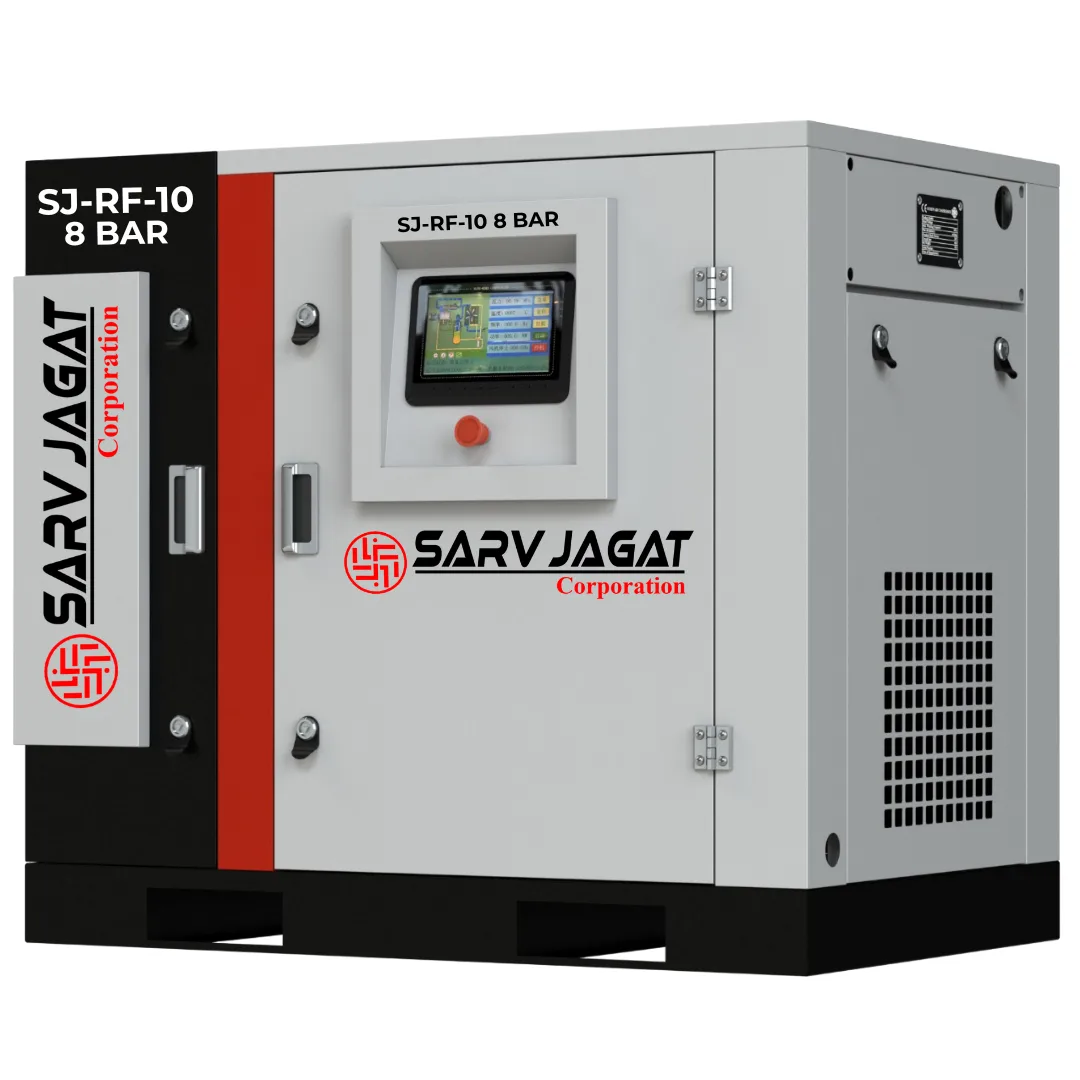
⚙️ Fixed Speed Drive
10 HP 8 Bar SJ Fixed Speed Screw Air Compressor
Buy 10 HP 8 Bar Fixed Speed Screw Air Compressor from Sarv Jagat. Delivers 45 CFM with reliable rotary screw technology, energy efficient & Low maintenance.
Power10 HP7.5 kW
Pressure8 Bar116 PSI
Air Delivery45 CFM1.27 m³/m
SJ RF 20Fixed
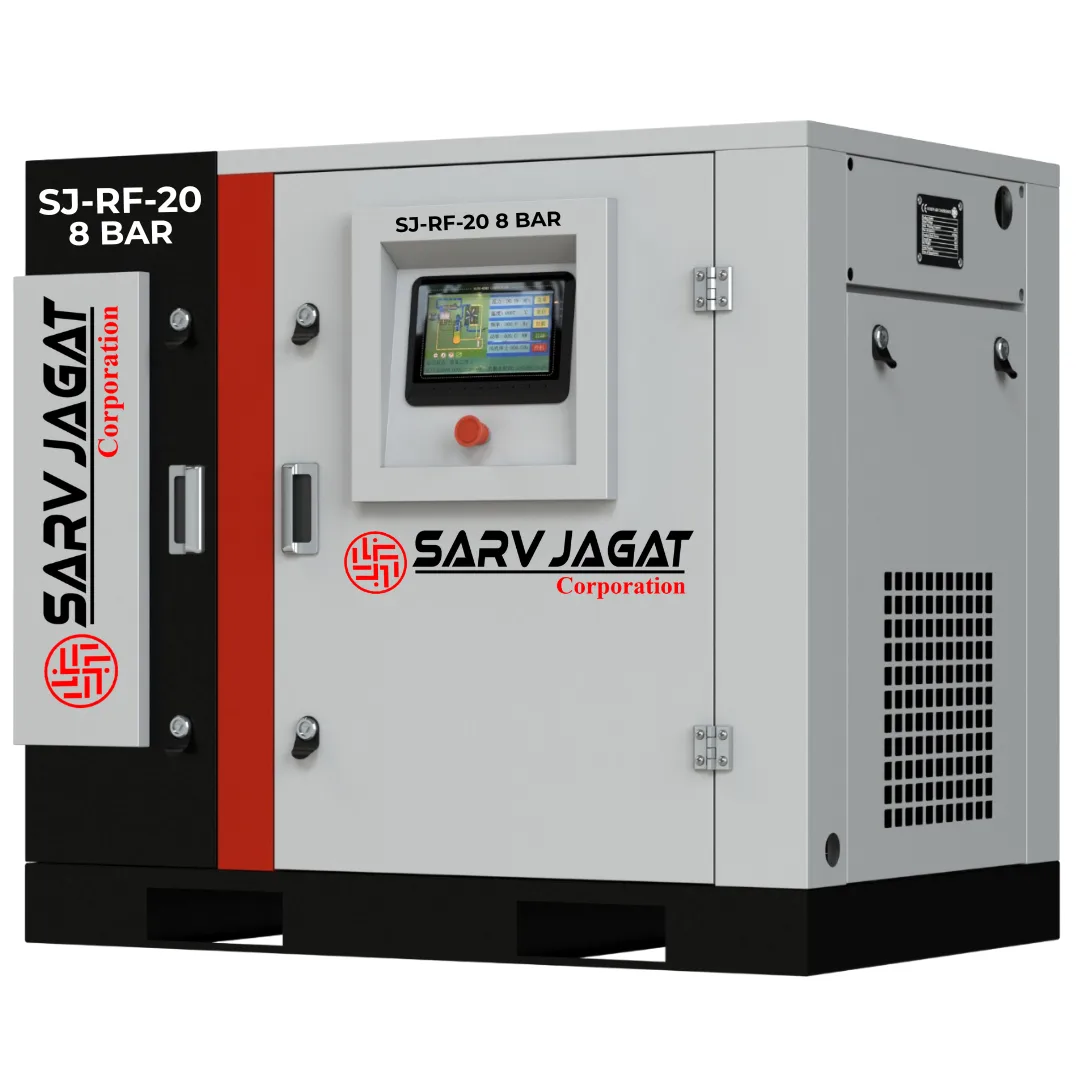
⚙️ Fixed Speed Drive
20 HP 8 Bar SJ Fixed Speed Screw Air Compressor
Buy SJ RF20 20 HP 8 Bar Fixed Speed Screw Air Compressor. 85 CFM (2.41 m³/min), oil injected rotary screw technology for industrial use.
Power20 HP15 kW
Pressure8 Bar115 PSI
Air Delivery85 CFM2.41 m³/m